

 Source of graphic: online version of the WSJ article quoted and cited below.
In class, we discuss how consumers pay higher prices for candy and soft drinks because the U.S. government limits on how much foregin sugar we can import. Sometimes a student will claim that candy companies would not lower prices if the price of sugar declined. And sometimes that issue leads to a discussion of whether the candy industry is competitive.
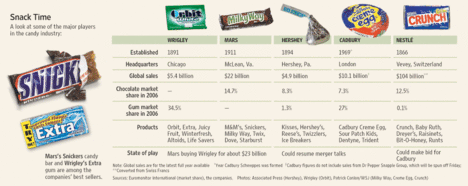
The graphic above, and the quotation below, provide some relevant evidence.
(p. B1) The global confectionary industry has long lacked a dominant player. The top 10 manufacturers controlled just 47% of the $141 billion market as of 2006, the most recent available data. . . .
. . .
If the Wrigley acquisition is successful, Mars will become the world’s largest confectionary company with about 14.4% of the market, overtaking Cadbury’s 10.1%, based on 2006 figures, the latest available, from Euromonitor International.
For the full story, see:
JULIE JARGON and AARON O. PATRICK. “More Sweet Deals in the Candy Aisle?; Cadbury and Hershey in the Spotlight in the Wake of Mars-Wrigley Linkup.” The Wall Street Journal (Tues., April 29, 2008): B1-B2.
(Note: ellipses added.)