
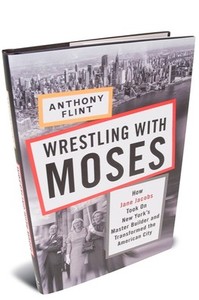
Source of book image: online version of the WSJ review quoted and cited below.
(A15) In her day, she was a tenacious activist and an opponent of powerful interests, courting disfavor in high places. But today everyone loves Jane Jacobs, and understandably so. The author of the now-classic “The Death and Life of Great American Cities” (1961) is widely regarded as a common-sense visionary who reminded people about what makes cities livable.
According to Anthony Flint, the author of ”Wrestling With Moses,” Jacobs’s most important contribution was the idea that “cities and city neighborhoods had an organic structure of their own that couldn’t be produced at the drafting table.” Mr. Flint, a former journalist who now works at the Lincoln Institute of Land Policy, clearly counts himself as a Jacobs fan. His book is a lively and informative valentine to her, aimed at showing us especially how she “took on New York’s master builder and transformed the American city.”
The villain of the story is Robert Moses, the ”master builder” who for four decades–from the 1930s into the 1960s–led several well-funded, quasi-governmental agencies and radically transformed the landscape of New York, building roads, bridges, tunnels, parks, playgrounds, beaches and public housing. Though he never held elective office, he was powerful indeed, establishing a formidable base in the city and state bureaucracies. He might have fallen into obscurity after his death if it were not for Robert Caro, who immortalized Moses in “The Power Broker” (1974), a massive biography that portrays Moses as a despot whose creations helped to destroy the city.
. . .
One roots for Jacobs every step of the way, not least because she rightly condemned the arrogance and elitism of urban planners. And Moses was, in fact, a bully who had acquired too much power and disregarded the concerns of local residents. Slum clearance too often targeted functioning working-class neighborhoods, and urban renewal went far beyond what its utopian aims could possibly deliver.
For the full review, see:
VINCENT J. CANNATO. “Not Here, She Said; How Jane Jacobs fought the ‘power broker’ to save the Village–and a city.” The Wall Street Journal (Thurs., July 29, 2009): A15.
(Note: ellipsis added.)
The source of the book being reviewed, is:
Flint, Anthony. Wrestling with Moses: How Jane Jacobs Took on New York’s Master Builder and Transformed the American City. New York, NY: Random House, Inc., 2009.