

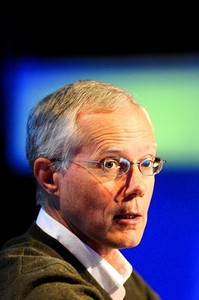
“Scott Cook.” Source of caption and photo: online version of the WSJ article quoted and cited below.
(p. B4) WSJ: Before building Intuit, you worked at large firms like Procter & Gamble Co. and Bain & Co. What prompted you to leave Corporate America and start your own business?
Mr. Cook: My wife complained about doing the bills. It was a hassle. I had been trained at P&G to find a problem that everybody has and that you could solve with technology. And this struck me as a classic entrepreneurial opportunity. Nobody likes to pay bills. There were about 20-plus personal-finance software products already on the market.
. . .
WSJ: How much start-up capital did have to work with?
Mr. Cook: We raised between $500,000 and $600,000. It came from my savings and my retirement plan that I cashed out. I also borrowed money from my parents. Lines of credit were another big source of capital. The banks were lending to me and my wife as a couple, not the business. We tried venture capital and that failed. We talked to about two dozen venture-capital firms and they all shut us down. We did get two angels to invest, but they put in only $151,000, total.
For the full interview, see:
SARAH E. NEEDLEMAN. “HOW I BUILT IT; For Intuit Co-Founder, the Numbers Add Up” The Wall Street Journal (Thurs., AUGUST 18, 2011): B4.
(Note: ellipsis added.)