
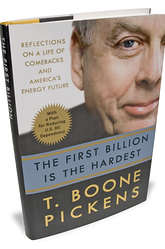
Source of book image: online version of the WSJ review quoted and cited below.
(p. A13) Both Adam Smith and Horatio Alger would find something to like in the rise of T. Boone Pickens. “Boy geologist” Boone quit a promising job at Phillips Petroleum in the mid-1950s and built, over the following decades, Mesa Petroleum, a top North American independent oil and gas producer. Mesa found lots of oil and gas, provided jobs for hundreds of workers, and earned wealth for thousands of investors. During the same years, Mr. Pickens’s attempts to take over Cities Service, Gulf Oil, Phillips and Unocal made the whole oil industry shape up: His bids required the managers of each company to look hard at its practices and improve its shareholder returns.
Such accomplishments are the core of Mr. Pickens’s 1987 autobiography, “Boone,” which was updated 13 years later and retitled “The Luckiest Guy in the World.” In those books, Mr. Pickens’s political philosophy rang loud and clear. “I believe,” he stated, “the greatest opportunity lies in a free marketplace.” He warned: “There are powerful forces afoot trying to restrict that freedom in the interests of the vested and already wealthy. I am talking about a relatively small collection of corporate executives who would use the engine of American commerce for their own narrow ends.”
. . .
Now Mr. Pickens has new dreams — and he is lobbying Washington to make them come alive.
In particular, Mr. Pickens wants the federal government — through a mix of tax incentives, mandates and subsidies — to override the market and redirect the uses of natural gas.
. . .
“The First Billion” argues for this plan, along with recounting Mr. Pickens’s business ups and downs. The book is often entertaining, featuring the usual “Boone-isms”: e.g., “Show me a good loser, and I’ll show you a loser.” But readers unfamiliar with Mr. Pickens’s earlier memoirs may not realize that the new one represents a kind of bait-and-switch. Mr. Pickens’s standing to pronounce on energy matters was earned as a free-market producer. He is now using that standing to defy the market itself.
For the full review, see:
ROBERT BRADLEY JR. “BUSINESS BOOKSHELF; When Effort Is Energetic.” The Wall Street Journal (Weds., September 10, 2008): A13.
(Note: ellipses added.)
The book under review is:
Pickens, T. Boone. The First Billion Is the Hardest: Reflections on a Life of Comebacks and America’s Energy Future. New York: Crown Business, 2008.