Main

September 14, 2008

Cubans Skeptical of Their Government


CubanCellPhone.jpg "Cubans used a cellphone to take photos in Havana recently after Cuba's government lifted some restrictions on consumer items." Source of caption and photo: online version of the NYT article quoted and cited below.

(p. A16) MEXICO CITY -- A rare study conducted surreptitiously in Cuba found that more than half of those interviewed considered their economic woes to be their chief concern while less than 10 percent listed lack of political freedom as the main problem facing the country.

"Almost every poll you ever see, even those in the U.S., goes to bread-and-butter issues," said Alex Sutton, director of Latin American and Caribbean programs at the International Republican Institute, which conducted the study. "Everybody everywhere is interested in their purchasing power."

The results showed deep anxiety about the state of the country, with 35 percent of respondents saying things were "so-so" and 47 percent saying they were going "badly" or "very badly." As for the government's ability to turn things around, Cubans were skeptical, with 70 percent of those interviewed saying they did not believe that the authorities would resolve the country's biggest problem in the next few years.

The study, to be released on Thursday, was conducted from March 14 to April 12, after Raúl Castro officially took over the presidency.


For the full story, see:

MARC LACEY. "In Rare Study, Cubans Put Money Worries First." The New York Times (Thurs., June 5, 2008): A16.

(Note: the order of some of the article content differed in the print and online versions; the version above is consistent with the print version.)

August 25, 2008

Castro's Legacy is Fear


CastroPhotosOnWall.jpg "A NATION'S PHOTO ALBUM. The prospect of life without Fidel Castro is unsettling to many Cubans, who are wary of drastic change." Source of caption and photo: online version of the NYT article quoted and cited below.

(p. 1) We arrived not at the fine new airport in Havana I've used many times as a correspondent, but at a smaller, more crowded one that Cuba uses for these family visits, as if to rebuke exiles for having left.

Our reunion was delayed, however, by the surprise announcement last Tuesday that Fidel Castro -- whose revolution had torn the family apart -- was too ill to return to power. Suddenly, I was at work.

. . .

Still, what most surprised us was how little Cubans clamored for drastic change. Dictator or hero, Mr. Castro's grip on power was ending, and no one seemed to care. Miriam was disappointed that the streets of Matanzas, Havana, San Agustín and Guanabacoa, the working class city across Havana Bay where she grew up, were tranquil, as if nothing at all had happened.

Of course we understood that things are not always as they seem, and that became clear when the maid in our 133-year-old hotel came to mop up the mess caused by a leaking pipe. Hearing the lilt of Miriam's Spanish put her at ease. After chatting for a few minutes, she poked her head into the hallway to check for supervisors and shut the door. Only then did she speak from the heart.

"Nobody says it, but everybody knows that someone new could be worse than what we have now," she whispered. It was the kind of dec-(p. 8)laration I've learned to trust because it stems from neither fear nor a desire to curry favor.

Despite having plenty of motivation to demand change -- the frequent shortages, the decrepit housing, the cruelty of having one currency for tourists and another with far less buying power for Cubans -- she said she feared change more than she feared the status quo. Then she checked the hallway again.

. . .

Truth is, things have changed since my first trip to Cuba in 1978. The heavy presence of the Soviet Union then is a faint shadow now, reflected in blue-eyed Cubans named Yuri. There seem to be more new cars on the roads, more fast food on the street, and more buildings undergoing repair. There even seem to be more buses and fewer people waiting for them since Fidel's younger brother and temporary replacement, Raúl, publicly demanded that something be done about the pitiful mass transit system when I was here just a year ago.

But much has not changed, or has gotten worse. More families live two or three generations in the same cramped apartments. Detention, interrogation and other troubles still descend on people who dissent in ways as small as wearing a plastic wrist band embossed with the word "cambio," which means change. The press is still controlled, and disloyalty to the Communist Party still raises the suspicion of neighbors that can lead to the loss of a job or a house. Dissidents remain enemies of the state.

. . .

The revolution itself has left many Cubans, including our relatives here, fed up with promises of change. They long ago tired of sacrificing for an ideal tomorrow; when we finally got together, three days after Fidel's announcement, Miriam's stepbrothers and sisters told me their main concerns are getting enough to eat, getting shoes for their children and getting to work on time each day.


For the full commentary, see:

ANTHONY DePALMA. "Future to Wince At." The New York Times, Week in Review Section (Sun., February 24, 2008): 1 & 8.

(Note: ellipses added.)

June 28, 2008

Raúl Castro Decrees that Cubans May Now Buy DVD Players, Computers, and Cell Phones


HavanaDVDplayer.jpg "Cubans in Havana recently bought DVD players, among newly available appliances." Source of caption and photo: online version of the NYT article quoted and cited below.

(p. A1) HAVANA -- Can a rice maker possibly be revolutionary?

There they were, piled up one atop another, Chinese-made rice makers selling for $70 each. Beside them, sleek DVD players. Across the well-stocked electronics store were computers and televisions and other household appliances that President Raúl Castro recently decreed ought to be made available to average Cubans, or at least those who could afford them.

Since finally succeeding his ailing 81-year-old brother, Fidel, in February, Mr. Castro, 76, who appeared before hundreds of thousands of Cubans at a May Day rally on Thursday here in the capital, has been busy with a flurry of changes. In the last eight weeks he has also opened access to cellphones, lifted the ban on Cubans using tourist hotels and granted farmers the right to manage unused land for profit.

More is on the horizon, government officials say, like easing restrictions on traveling abroad and the possibility of allowing Cubans to buy and sell their own cars, and perhaps even their homes. Each of these changes may be microscopic in contrast to the outsize problems facing Cuba. But taken together, they are shaking up this stoic, time-warped place.


For the full story, see:

MARC LACEY. "Stores Hint at Change Under New Castro." The New York Times (Fri., May 2, 2008): A1 & A8.

February 11, 2008

Cubans Salute General Eléctrico


      "Two artists, Alejandro Leyva, left, and Esteban Leyva, with their "General Eléctrico," found a new use for an old appliance."  Source of caption and photo:  online version of the NYT article quoted and cited below. 


(p. 3)  In their decades of isolation from the American economy and from global prosperity, Cubans have been taught to take pride in the way they have kept grandiose old mechanical marvels running -- ancient Cadillacs and Russian-built Ladas included.


"They took away my señor and replaced him with a little guy," said a 47-year-old cook who lives in the Reparto Zamora district in western Havana. Welcoming a visitor to her kitchen, she pointed to the slim, white Chinese-made Haier that had taken the place of the bulky, pink Frigidaire that had been in her family for 24 years.


She called herself Moraima Hernández, but indicated with a wink that she was concealing her real name -- the only way she felt able to speak without fear of retaliation. Well, up to a point. She declined to say why she felt Mr. Castro was casting a shadow over items as banal as household appliances.


Instead, she simply opened the Haier to reveal its meager contents: bottles of tap water, a few eggs, mustard, half an avocado and some "textured picadillo," soy protein mixed with a bit of ground beef.


Her old refrigerator was so big, she said nostalgically, that two legs of pork could fit inside.


. . .


Inspired by the ingenuity it took to keep American refrigerators working so long, a group of Cuban artists last year transformed 52 of them into art. They put on a show called "Instruction Manual" that was a big hit in Cuba and is making the rounds in Europe this year.


In the show, the artists Alejandro and Esteban Leyva pinned medals on an old G.E. refrigerator, painted it olive drab and named it "General Eléctrico." Another artist, Alexis Leyva, installed oars on his refrigerator, drawing on the politically loaded symbol of the homemade boats Cubans use to leave the island illegally. Others were made into cars, skyscrapers a Trojan horse and a jail cell.


Ernesto García Peña, a painter, turned his into an eroticized female image. "In this heat," he explained, "the refrigerator is almost worshiped for its role as an absolute necessity of modern life. We treat it with very special affection."


For the full story, see: 


SIMON ROMERO.  "THE WORLD; In Cuba, a Politically Incorrect Love of the Frigidaire."  The New York Times , Week in Review Section  (Sun., September 2, 2007):  3.


(Note:  ellipses added.)


  "Cold War Relic.   A 1950s-era American refrigerator dominates one woman's Havana apartment."  Source of caption and photo:  online version of the NYT article quoted and cited above. 


December 4, 2007

Cuba's Best Doctors Not Blind to Incentives Offered by "Communist" Government


   "Patients at the Ramón Pando Ferrer eye hospital in Havana."  Source of caption and photo:  online version of the NYT article quoted and cited below.


(p. A4)  Cuban doctors abroad receive much better pay than in Cuba, along with other benefits from the state, like the right to buy a car and get a relatively luxurious house when they return. As a result, many of the finest physicians have taken posts abroad.

The doctors and nurses left in Cuba are stretched thin and overworked, resulting in a decline in the quality of care for Cubans, some doctors and patients said.


For the full story, see:   

JAMES C. McKINLEY Jr.  "Havana Journal;  A Health System’s ‘Miracles’ Come With Hidden Costs."  The New York Times   (Tues., November 20, 2007):  A4. 


November 13, 2007

In Cuba, to Survive "You Have to Resort to the Black Market"


Lady Liberty is rightly aghast at life in Havana.  Source of photo:  online version of the NYT article cited below.


My friend Luis Locay has warned me in the past to be sceptical of articles that express optimism about Raul Castro being a friend of the free market.  One such article is excerpted below.  (I am hoping Luis is wrong.) 


Raúl Castro has taken several small but meaningful steps over the last year that suggest that he wants to open up Cuban society and perhaps move to a market-driven system, without ceding one-party control, not unlike what has happened in China. During the 1990s, he supported limited private enterprise and foreign investment, reforms his brother reversed four years ago.

. . .

On the economic front, Raúl Castro has allowed the importation of televisions and video disc players. He has told the police to let pirate taxis operate without interference. He pledged to spend millions to refurbish hotels, marinas and golf courses. He even ordered one of the state newspapers to investigate the poor quality of service at state-controlled bakeries and other stores.

Perhaps his most important step, however, was to pay the debts the state owed to private farmers and to raise the prices the state pays for milk and meat. Cubans still live on rations and cope with chronic shortages of staples like beef. Salaries average about $12 a month, and most people spend three-quarters of their income on food, according to a study by Armando Nova González, an economist at the Center for the Study of the Cuban Economy in Havana.

“What a person makes is not enough to live on,” said Jorge, a museum guard who asked that his last name not be used because he feared persecution. “You have to resort to the black market to get along. No, not just to get along, to survive.” He said he and his wife together made about $30 a month, just enough to support their family of four.

But Raúl Castro has disappointed many Cubans who had expected significant changes once he took power. He has always deferred to his brother, and he seems to lack the political power to take major actions until Fidel either gives up total control or dies, experts on Cuba said.


For the full story, see:

JAMES C. McKINLEY, Jr.  "Cuba’s Revolution Now Under Two Masters."  The New York Times  (Fri., July 27, 2007):  A3.


  The top photo shows Raúl Castro giving the annual speech celebrating the Cuban revolution.  (Fidel Castro became ill after the previous year's speech.)  The lower photo shows the reaction to Raúl's speech from the crowd.


August 23, 2007

"I Couldn't Write a Prescription for Antiobiotics, Because There Were None"


    "THE DOCTOR MIGHT BE IN Cubans young and old at a Havana clinic in 2004."  Source of caption and photo:  online version of the NYT article cited below. 


CUBA works hard to jam American TV signals and keep out decadent Hollywood films. But it’s a good bet that Fidel Castro’s government will turn a blind eye to bootleg copies of “Sicko,” Michael Moore’s newest movie, if they show up on the streets of Havana.

“Sicko,” the talk of the Cannes Film Festival last week, savages the American health care system — and along the way extols Cuba’s system as the neatest thing since the white linen guayabera.

Mr. Moore transports a handful of sick Americans to Cuba for treatment in the course of the film, . . .

. . .

Universal health care has long given the Cuban regime bragging rights, though there is growing concern about the future. In the decades that Cuba drew financial and military support from the Soviet Union, Mr. Castro poured resources into medical education, creating the largest medical school in Latin America and turning out thousands of doctors to practice around the world.

But that changed after the collapse of the Soviets, according to Cuban defectors like Dr. Leonel Cordova. By the time Dr. Cordova started practicing in 1992, equipment and drugs were already becoming scarce. He said he was assigned to a four-block neighborhood in Havana Province where he was supposed to care for about 600 people.

“But even if I diagnosed something simple like bronchitis,” he said, “I couldn’t write a prescription for antibiotics, because there were none.”

He defected in 2000 while on a medical mission in Zimbabwe and made his way to the United States. He is now an urgent-care physician at Baptist Hospital in Miami.

Having practiced medicine in both Cuba and the United States, Dr. Cordova has an unusual perspective for comparison.

“Actually there are three systems,” Dr. Cordova said, because Cuba has two: one is for party officials and foreigners like those Mr. Moore brought to Havana. “It is as good as this one here, with all the resources, the best doctors, the best medicines, and nobody pays a cent,” he said.

But for the 11 million ordinary Cubans, hospitals are often ill equipped and patients “have to bring their own food, soap, sheets — they have to bring everything.”  . . .

. . .

Until he had to have emergency surgery last year, Fidel Castro — who turned 80 this year — was considered a model of vibrant long life in Cuba. But it was only last week that he acknowledged in an open letter that his initial surgery by Cuban doctors had been botched. He did not confirm, however, that a specialist had been flown in from Spain last December to help set things right. 


For the full commentary, see: 

ANTHONY DePALMA.  "‘Sicko,’ Castro and the ‘120 Years Club’."  The New York Times, Section 4  (Sun., May 27, 2007):   3. 

(Note:  ellipses added.)


August 19, 2007

Fred Thompson Skewers Michael Moore with Wit and Wisdom


ThompsonFredSenator.jpg   Former Senator Fred Thomspson.  Source:  online version of the WSJ article cited below.


Mr. Moore was back from Cuba, where he made a documentary on the superiority of Castro's health-care system. Mr. Thompson suggested Mr. Moore is just another lefty who loves dictators. Mr. Moore challenged Mr. Thompson to a health-care debate and accused him of smoking embargoed cigars. Within hours Mr. Thompson and his supposedly nonexistent staff had produced a spirited video response that flew through YouTube and the conservative blogosphere. Sitting at a desk and puffing on a fat cigar, Mr. Thompson announces to Mr. Moore he can't fit him into his schedule. Then: "The next time you're down in Cuba . . . you might ask them about another documentary maker. His name was Nicolás Guillén. He did something Castro didn't like, and they put him in a mental institution for several years, giving him devastating electroshock treatments. A mental institution, Michael. Might be something you ought to think about."

You couldn't quite tell if Mr. Thompson was telling Mr. Moore he ought to think more about Cuba, or might himself benefit from psychiatric treatment. It seemed almost . . . deliberately unclear.


PEGGY NOONAN.  "DECLARATIONS; The Man Who Wasn't There."  The Wall Street Journal  (Sat., May 19, 2007): P14.

(Note:  ellipsis in original.)


See Fred Thompson's response to Michael Moore on YouTube at:

http://www.youtube.com/watch?v=Ds_GhRxivOI  


    Source:  screen capture from Fred Thompson's response to Michael Moore at http://www.youtube.com/watch?v=Ds_GhRxivOI


April 21, 2007

Castro's Legacy of "Death, Tears and Blood"

Like thousands of other Cubans, I was arrested in the middle of the night. Fidel Castro's police raided my parents' home, stuck a machine gun in my face and took me away. It was 1960 and I was 22 years old.

The news that the Cuban dictator is gravely ill floods my mind with memories of my years spent in captivity. I believe that those of us who were political prisoners know his legacy better than anyone. For 22 years, I was an inmate in his vast prison system, mostly confined to an island gulag, for crimes I did not commit.

. . .

The legacy of Castro for Cuba will be much like that of Stalin in Russia, Pol Pot and Ieng Sari in Cambodia and Hitler in Germany. It will be the memories of the unknown numbers of victims, of concentration camps, torture, murder, exile, families torn apart, death, tears and blood. Castro will go down in history as one of the cruelest of all dictators -- a man who tormented his own people.

But his poisonous legacy will also include the double standard by foreign governments, intellectuals and journalists who fought ferociously against the unspeakable violations of human rights by right-wing dictatorships, yet applauded Castro. To this day many of these intellectuals serve as apologists and accomplices in the subjugation of the Cuban people. Rafael Correa, the recently inaugurated president of Ecuador, has declared that in Cuba there is no dictatorship. Evo Morales, president of Bolivia, considers Castro his mentor and has already shown that he is willing to silence his own critics at the point of a gun. Venezuela, once a democracy, is the new Cuba, replete with a growing population of political prisoners.


For the full commentary, see: 

ARMANDO VALLADARES.  "Castro's Gulag." The Wall Street Journal  (Mon., March 5, 2007):  A16.


August 23, 2006

Cuban Bureaucrats Fooled by Castro Impersonator

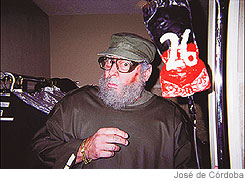
CastroImpersonator.jpg  Castro impersonator Eddy Calderón.  Source of photo:  online version of WSJ article cited below. 


(p. A1)  Mr. Calderón says the work can be risky.  Once, he recalls, a woman whose relative had been executed by the revolution hurled a dinner plate at his head.  At a recent gig, a tiny, white-haired lady shouted at him:  "Why did you ruin the country?" Mr. Calderón, as Fidel, answered that she should thank him because if it hadn't been for him, she'd be stuck in Cuba instead of living well in Miami, "where you can buy hair dye and dentures."

After the Aug. 13 performance, a ballroom attendant, Armando Montes de Oca, approached Mr. Calderón while he was still in his Castro beard and told him:  "If I didn't know you were Calderón behind that beard, you would never leave (p. A9) this room alive."

"Thank you," Mr. Calderón replied.

Mr. Calderón has been doing his imitation of Fidel for about a dozen years.  He became a local superstar two years ago when a cable-TV channel started weekly broadcasts of a skit called "La Mesa Retonta," or "The Idiots' Table," a takeoff on a weekly "Meet the Press"-style show Mr. Castro has done in Cuba, called "La Mesa Redonda," or "The Roundtable."

Mr. Calderón's Fidel voice is so good that on about 50 occasions, he has telephoned Cuban bureaucrats in Havana or Cuban diplomats abroad and fooled them into thinking they were on the line with the man himself.  Mr. Calderón taped the calls, which he still often plays on a Miami radio show.

Two years ago, Mr. Calderón held a 12-minute conversation with Cuba's deputy construction minister, ordering him to build a giant retractable roof over Havana's Latin American stadium, as a way to improve conditions for Cuban baseball players and dissuade them from defecting.

"We need a revolutionary roof to uphold the pride of the Cuban Revolution," said Mr. Calderón during the taped telephone call, in a dead-on imitation of Mr. Castro's edgy, high-pitched, nasal voice.

"I am your unconditional soldier," replied the hapless minister, who promised to get the job done.

That same year, Mr. Calderón telephoned a luxury hotel at Cuba's Varadero beach resort and ordered the hotel manager to provide a week-long all-expense-paid vacation for one of Cuba's leading dissidents, whose movements are shadowed by the secret police, to show the government's good will.  Before hanging up, the hotel manager, Mr. Calderón says, promised to make the reservation.

A year earlier, Mr. Calderón as Fidel told transport official Gumersindo Gómez to round up 200 scarce buses for an outing of some 700 priests of the Afro-Cuban religion Santería, and to find room for their sacrificial goats and chickens.  Make sure the buses don't have any graffiti saying "down with You-Know-Who," he added.

"Fatherland or death," Mr. Calderón said.

"Onwards to victory," replied Mr. Gómez, according to the tape of the phone call.


For the full story, see:

JOSÉ DE CÓRDOBA.  "Fidel Castro's Illness Has Impersonators Scrambling to Adapt In Miami; Mr. Calderón Does El Jefe's Voice Perfectly; New Role for Brother Raúl."  Wall Street Journal  (Fri., August 18, 2006):  A1 & A9. 

April 28, 2006

"Damn it Fidel! What are you going to do about this lousy, piece-of-**** island of yours?"


   Source of image of book:  http://www.amazon.com/gp/product/1586483242/qid=1145298612/sr=2-1/ref=pd_bbs_b_2_1/104-9985403-1047968?s=books&v=glance&n=283155


Fernando Cardosa is the former Brazilian President who is best known for having temporarily tamed Brazil's runaway inflation.  Although not a principled believer in the free market, Cardoso made some efforts to reduce the damage the Brazilian government was doing to the economy.  The following startling passage is from a useful review of a new memoir by Cardoso:


. . . ,  Mr. Cardoso mentions a telling moment at a 1999 summit meeting in Havana.  When the heads of state were alone at a luncheon, one said to Castro:  "Damn it Fidel!  What are you going to do about this lousy, piece-of-**** island of yours?   We're sick of apologizing for you all the time, Fidel.  It's getting embarrassing."   The anecdote shows how disingenuous Latin governments can be when they remain silent about the Cuban dictatorship.


For the full review, see:

MARY ANASTASIA O'GRADY.  "A Leader Who Got Real."  The Wall Street Journal  (Thurs., April 6, 2006):  D8.

(Note:  ellipsis added.)


Here is the full reference to Cardoso's memoir:

Cardoso, Fernando Henrique.  The Accidental President of Brazil:  A Memoir.  PublicAffairs, 2006.  [with Brian Winter;  291 pages;  $26.95]


HP3D5006CropSmall.jpg


Powered by
Movable Type 4.1


Amazon Honor System Click Here to Pay Learn More


View My Stats

The StatCounter counter box above reports the number of "page loads" since the counter was installed late on 2/26/08. A "page load" is "The number of times your page has been visited."